




Balcony Solar System with Storage for 4 Panels: A Complete Guide for Homeowners
As electricity prices remain high across Germany, more homeowners are looking for ways to increase self-consumption and reduce dependence on the grid. While traditional balcony solar systems often use two modules, four-panel systems are becoming increasingly popular because they generate significantly more energy and offer faster returns.9/11/2026
However, generating more solar power is only half the story. Without the right storage solution, much of that extra energy may still go unused.
In this guide, we'll explain why four-panel balcony solar systems are gaining popularity, how storage improves their performance, and what to consider when choosing a battery system.


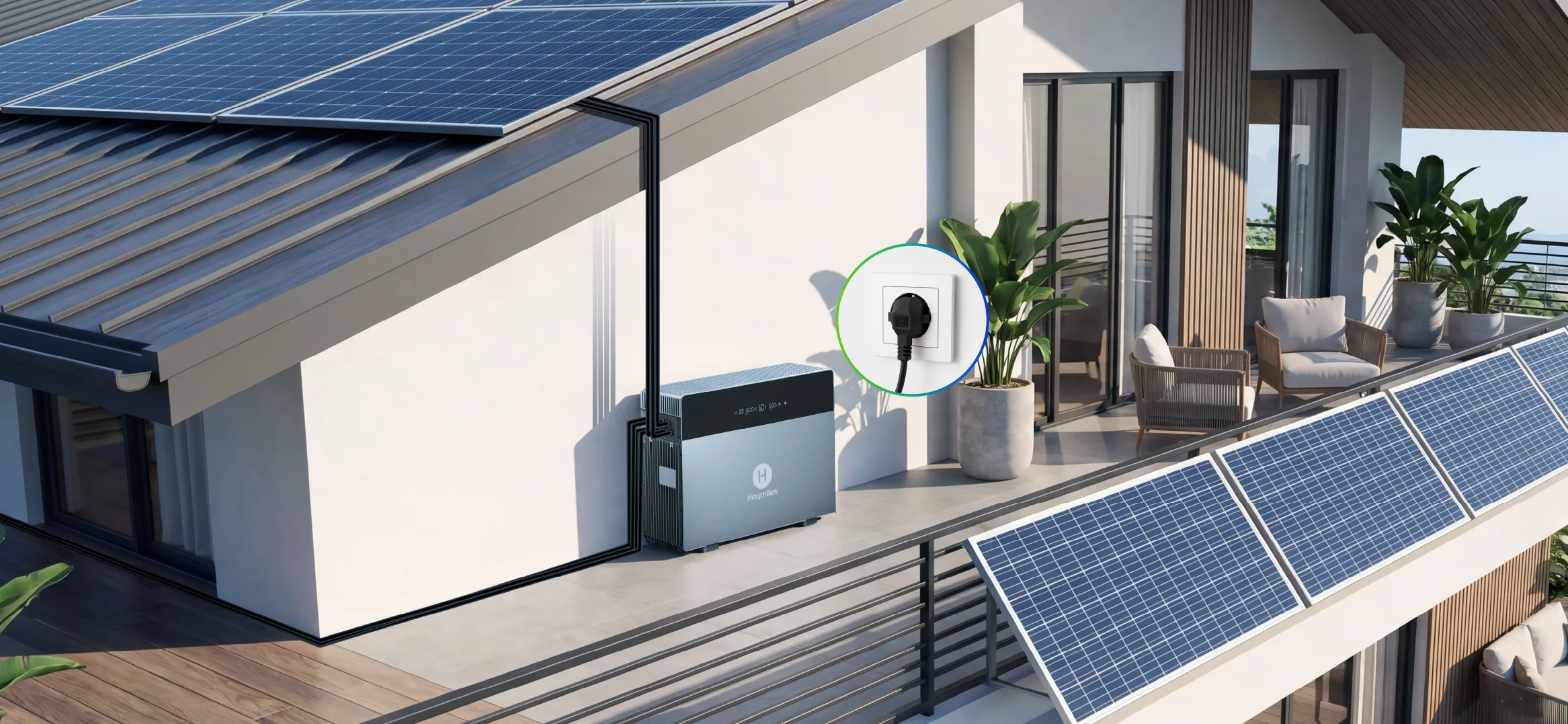
Why 4 Panels for a Balcony Solar System? A Market Overview
Germany's balcony solar market is growing rapidly thanks to recent regulatory changes. The latest rules allow plug-in solar systems to be connected via a standard Schuko plug, while the permitted inverter output has been increased from 600W to 800W.
At the same time, registration requirements have been simplified, making balcony solar systems easier than ever to install for both homeowners and tenants.
As electricity prices remain high, many households are looking beyond traditional two-panel systems. A four-panel setup with around 2,000W of PV capacity can generate approximately 2,300–2,500 kWh of electricity per year under German conditions, helping homeowners offset a larger share of their annual energy consumption.
However, generating more solar power is apparently not enough. Since 2024, Germany has gradually reduced feed-in tariffs for newly installed PV systems. For residential rooftop systems below 10 kWp commissioned after August 2025, surplus electricity exported to the grid receives only around €0.0786/kWh under the partial feed-in model.
By comparison, retail electricity prices for households often exceed €0.35–0.40/kWh.
9/11/2026This means every kilowatt-hour consumed directly within the home is worth several times more than electricity exported to the grid. Instead of selling surplus solar energy at a relatively low rate, homeowners can store it during the day and use it during the evening, significantly improving the economic return of their solar investment.
For this reason, homeowners increasingly need a battery storage solution to make better use of solar power for their own good.
What Is a Hybrid Inverter with 4 MPPTs for a Balcony Solar System and Why We need It?
Balcony-mounted solar often faces partial shading and mixed-orientation panels. For conventional single-MPPT systems, the whole PV string is constrained by the weakest-performing panel. Orientation deviation, shadows from buildings or trees, and dust can reduce individual-panel output and trigger unexpected systemlevel energy loss, even if other panels receive ample sunlight.
An MPPT (Maximum Power Point Tracking) continuously adjusts the operating point of a solar panel to extract the maximum available power.
The more independent MPPTs a system has, the better it can handle different panel orientations and varying sunlight conditions.
This becomes particularly important in four-panel balcony solar systems, because it’s very likely that the four panels do not have the same orientations.
With four independent MPPTs:
Each PV input operates separately.
Shading on one panel does not significantly affect the others.
East-, west-, and south-facing modules can all work at their optimal output.
Overall energy harvest is increased.
Each independent MPPT channel works for one PV input individually. Panels facing east, west or south have distinct irradiance curves over the day: east-facing panels peak in the morning, west-facing panels peak in the afternoon, and south-facing panels deliver stable output at noon.
A single shared MPPT can only lock to one unified operating point, forcing all panels to compromise and sacrifice performance. With four separate MPPTs, every panel can follow its own power curve and stay at its personal maximum-power point, no compromise required.
In addition, a hybrid inverter combines solar generation and battery storage management into a single system. During the day, excess solar energy is stored in the battery instead of being exported to the grid. At night, the stored energy powers household loads, significantly increasing self-consumption.
How Does a Balcony Solar System with Storage for 4 Panels Work?
The operation is straightforward.
During the day:
Solar panels generate electricity.
Household appliances use solar energy first.
Surplus energy charges the battery.
During the evening:
The battery supplies stored solar energy.
Grid electricity is only used when necessary.
This approach allows homeowners to consume much more of their own solar production instead of feeding excess electricity into the grid at relatively low compensation rates.
Depending on system size and consumption patterns, self-consumption rates can increase from around 20–30% to as much as 80–90%.
Hoymiles HiBattery 4020 X: The Ideal Solution for 4 PV Panels and High Electricity Demand
The Hoymiles HiBattery 4020 X is specifically designed for homeowners who want to maximize the value of larger balcony solar systems.
Four Independent MPPTs
Unlike many balcony storage products that offer only one or two MPPTs, the HiBattery 4020 X features four fully independent MPPT inputs. This maximizes production under complex installation conditions and partial shading. Up to 8 solar panels can be connected to the battery, with two sharing one MPPT.
Up to 4000W PV Input
The system supports up to 4000W of PV input. Whether homeowners start with four modules or later expand to eight modules, the system can grow with your energy needs.
Moreover, the HiBattery 4020 X is designed to work with most popular solar modules.
Key specifications include:
Maximum PV input power: 4000W
Maximum input voltage: 60V
Maximum input current: 32A
Startup voltage: 18V
Most 450W–600W solar modules on the German market operate comfortably within these ranges, making system design simple and flexible.
Expandable Energy Storage
HiBattery 4020 X starts with 4 kWh of basic storage capacity and can be expanded up to 16 kWh using additional battery stacks.
This flexibility allows homeowners to choose the right storage size today while retaining the option to expand in the future.
Selection & Sizing: Which Storage System Suits Your 4 Panels? And Use Cases
Choosing the right storage capacity depends primarily on annual electricity consumption.
Annual Consumption | Recommended Storage Capacity |
2,000–2,500 kWh | 4 kWh |
3,000–4,000 kWh | 8 kWh |
4,000–5,000 kWh | 12–16 kWh |
A battery that is too small may fill quickly and waste surplus solar energy. A battery that is too large may take longer to achieve an attractive return on investment.
For many households, starting with a smaller configuration and expanding later provides the best balance between cost and flexibility.
But how does this calculation fit into your daily life? Now we’ll look at some typical home settings to illustrate what system size you should choose.
Scenario 1: Small Household (1–2 People)
l Annual electricity consumption: 2,000–2,500 kWh l Estimated annual solar generation: 2,378 kWh l Estimated daily solar generation: 5.96 kWh |
System configuration:
✅️ 1 × HiBattery 4020 X ✅️ 4 × 500W solar modules |
Energy Usage: l On average, 1.79 kWh of solar energy is used to power house appliances l The remaining 4.17 kWh can be stored in battery for night use | |
Benefits: l Overall self-consumption rate 90% l Estimated annual savings: €856 per year | |
Ideal for apartments, small homes, and households looking to maximize energy independence without oversizing their system | |
Scenario 2: Family Household (3–5 People)
l Annual electricity consumption: 3,000–5,000 kWh l Estimated annual solar generation: 4,757 kWh l Estimated daily solar generation: 13 kWh |
System configuration: ✅️ 1 × HiBattery 4020 X ✅️ 1–3 expansion batteries ✅️ 8 × 500W solar modules |
Energy Usage: l Case 1: 2.6 kWh of solar energy is used to power house appliances; the remaining 10.4 kWh can be stored in battery for night use l Case 2: 5.2 kWh of solar energy is used to power house appliances; the remaining 7.8 kWh can be stored in battery for night use | |
Benefits: l Overall self-consumption rate 90% l Estimated annual savings: €1,712per year | |
✳This setup is particularly suitable for larger households with higher daytime and evening electricity demand. | |
How Much Money Can You Save with a 4-Panel Balcony Solar System?
The economic benefits of combining four solar panels with battery storage is substantial.
Without storage, a typical balcony solar system may only achieve a self-consumption rate of 20–30%, meaning much of the generated electricity is exported to the grid.
With battery storage, self-consumption can increase to around 80–90%, allowing homeowners to use far more of their own solar energy.
Assuming an electricity price of €0.40/kWh:
Small household system: approximately €856 annual savings
Family household system: up to €1,712 annual savings
Under favorable conditions, the payback period can be as short as two years, making a balcony solar system with storage one of the most attractive residential energy investments available today.
Conclusion
As German households continue to seek greater energy independence, four-panel balcony solar systems are becoming an increasingly popular choice.
However, higher solar generation also requires smarter energy management. Storage systems equipped with multiple MPPTs can help homeowners overcome challenges such as shading, mixed panel orientations, and fluctuating energy demand.
With four independent MPPTs, up to 4000W PV input, and expandable storage capacity of up to 16 kWh, the Hoymiles HiBattery 4020 X provides a flexible solution for homeowners looking to maximize self-consumption and long-term savings.
Whether you're building your first balcony solar system or upgrading an existing installation, pairing four solar panels with intelligent battery storage can help you get the most value from every kilowatt-hour you generate.


Subscribe to our newsletter and get the latest news!