




Maximizing balcony solar performance in winter | Hoymiles


How to Maintain the Best Performance for Your Balcony Solar Power Plant in Winter
As temperatures drop and sunlight hours shorten, many balcony solar users notice a decline in energy output. Winter indeed brings challenges like snow accumulation, freezing temperatures, low sun angles, and shorter daylight. But that doesn’t mean your balcony solar has to hibernate until spring. With the right maintenance and technology, you can keep your balcony power plant running efficiently throughout the whole winter.
In this guide, we’ll walk you through practical tips to maximize your solar performance in cold months and explain how the latest plug-in solar storage product HiBattery AC’s self-heating function keeps your system winter-proof, even at -20°C.
Understand how winter affects your balcony solar system
First, let’s see how different components of your balcony solar system are affected by freezing winter. Knowing these limitations helps you plan ahead and choose the right equipment for cold climates.
Solar panel
What’s counterintuitive is that cold weather can actually improve solar panel efficiency—a phenomenon known as the low-temperature effect. That’s because at lower temperatures, electrons move faster, improving energy conversion and output. Cooler conditions also slow material degradation, helping panels maintain performance and last longer. However, reduced sunlight, snow cover, and shading often offset that advantage:
Reduced solar radiation: Shorter days mean fewer hours of peak production.
Snow and frost buildup: Even a thin layer can block light and drastically reduce output.
Microinverter
In cold weather, the open-circuit voltage (Voc) of solar panels increases, which in turn raises the microinverter’s system voltage. Excessively high Voc can trigger the inverter’s overvoltage protection, causing it to shut down temporarily and, in severe cases, affect overall performance.
Moreover, the temperature-sensitive components inside the microinverter may experience stress when operating in low temperatures. As the inverter starts up, rapid temperature fluctuations can occur, potentially reducing component reliability and shortening its lifespan over time.
Battery
Most lithium batteries lose capacity in freezing temperatures, limiting storage efficiency. As temperatures drop, internal chemical reactions slow down, reducing charging efficiency and capacity. Prolonged exposure to freezing conditions may even cause irreversible cell damage, lowering storage performance. Low temperatures also raise the risk of deep discharge, meaning that batteries tend to drain faster in winter. Without proper care, this can shorten lifespan and reduce reliability.
Keep your panels clean and clear of snow
Snow is one of the biggest contributors to energy loss in winter. Even partial shading can cut output by 50% or more.
There are a lot of tips to maintain your solar panels, among which the most straightforward ones are as follows:
Use a soft brush or squeegee to gently clear snow (use an extension handle if needed). Avoid sharp tools that could scratch the surface.
Don’t use hot water, as sudden temperature changes can damage the glass.
Tilt your panels if possible. A steeper angle helps snow slide off naturally and captures more low-angle sunlight.
Don’t forget to conduct regular maintenance to make sure your solar panels are always in optimal conditions. If your panels are difficult to access, wait for the sun to do its job. Dark panels absorb heat and can melt snow faster than you think.
Keep your battery indoors
Whenever possible, place your battery in a sheltered or indoor place, such as garage, basement, balcony cabinet, or attic. Protecting them from direct exposure to freezing temperatures and moisture helps maintain stable operation and extend their lifespan. Indoor installation also reduces thermal stress, ensuring your system performs efficiently even during harsh winter weather.
For hybrid solutions where the inverter and battery are integrated in one unit, solar panels are directly connected to the storage, so you’ll need long extension cables to actually put the product indoors. Otherwise, the battery will be exposed to winter cold, which can compromise the overall performance.
That is why we recommend AC-coupled solution, a more flexible option to keep your battery warm indoors. Plug-in solar battery like HiBattery AC can be installed independently from the microinverter, so it can be placed anywhere and plugged into a home socket—no cable wiring needed.

Monitor your system performance regularly
Regular checks help you detect issues early—whether it’s reduced voltage, inverter faults, or shading from nearby trees or structures.
Make sure to keep an eye on:
Sudden drops in production: Could indicate dirt, frost, or snow accumulation.
Error messages or offline alerts: May suggest connection or temperature-related faults.
Battery discharge behavior: If you notice reduced capacity or slower charging, your system might be struggling with the cold.
Many solar manufacturers offer their own apps to show everything about the system operation. Make sure to check out the data from time to time, and address any alerts as soon as possible. Monitoring ensures that small issues don’t escalate into major performance losses.
For example, Hoymiles HiBattery AC balcony battery offers a clear LED display to show everything essential about the system. From the moment energy flows to the full picture of your home power, the S-Miles Home app makes every watt traceable, which allows you to stay on top of how your system performs.

Use high-quality components built for winter
Choosing equipment designed for sub-zero operation makes all the difference for the
When buying or upgrading, consider:
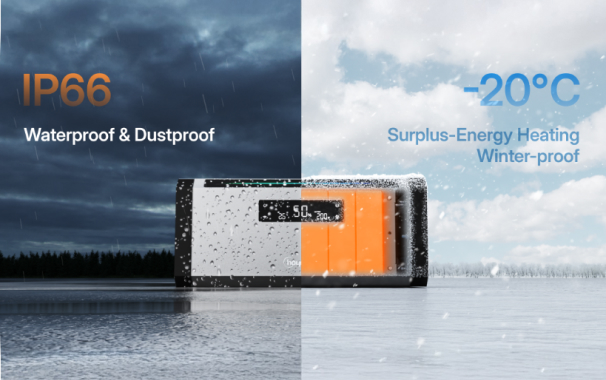
Microinverters with at least IP66 protection rating
Batteries that are equipped with self-heating function to maintain optimal operation in winter.
That’s where HiBattery AC stands out. Unlike conventional batteries that lose power below freezing, HiBattery is equipped with surplus-energy heating, a self-heating system that activates automatically in low temperatures.
Hoymiles HiBattery AC: Self-heating function for reliable power even at -20°C
The biggest challenge in winter is not sunlight, but the cold’s impact on battery chemistry. Traditional lithium batteries can’t charge properly below 0°C. Charging them at such low temperatures can even cause permanent damage.
Hoymiles HiBattery AC solves this with advanced self-heating technology that converts surplus solar energy into heat before charging begins. This ensures optimal performance and longevity, even at -20°C.
How battery self-heating works
The battery’s self-heating feature is mainly triggered by two factors: temperature and available surplus PV power.
When the temperature of battery cell drops below 0°C, the battery cannot charge at all. In this case, as long as the PV system generates more power than what battery heating needs, the system will automatically turn on self-heating.
When the temperature rises above 0°C, the battery can start charging, but only at a limited level. The system will always prioritize supplying the power that battery charging needs. Only if there is still extra PV power—and it’s enough to cover the heating demand—will the system continue heating.
Throughout the process, the Battery Management System (BMS) constantly monitors the cell temperature and charging capability, while the micro storage battery evaluates the PV output to decide whether to start self-heating.
Key advantages of HiBattery in winter:
Automatic surplus-energy heating: Uses extra generated power to warm up the cells. Beyond simply heating the battery in sub-zero conditions, the system also activates self-heating whenever battery charging and discharging are limited by low temperatures with surplus energy. This constantly keeps the battery at optimal operating performance more quickly.
Operational down to -20°C: Reliable energy storage in freezing weather.
Smart control system: Automatically adjusts heating and charging cycles for efficiency.
Extended battery life: Prevents cold-related degradation and ensures stable voltage output.
Flexible heating power: Compared with the previous MS-A2 that requires a fixed 100 W power to start heating, HiBattery AC has no limitation—even 10 W or 20 W excess energy can activate self-heating.
With HiBattery AC, you don’t have to worry about low temperatures reducing the balcony solar performance.

Stay powered, even in the cold
Winter doesn’t have to mean reduced solar performance. With the right preparation—clean panels, regular monitoring, and winter-ready technology—you can enjoy consistent energy generation all year long.
And with HiBattery AC’s self-heating function, you get peace of mind knowing your storage will keep performing—even when temperatures drop to -20°C.
So, don’t let the cold slow you down. Equip your balcony power plant with HiBattery AC and keep your clean energy flowing this winter.
<Heat up winter with HiBattery AC>


Subscribe to our newsletter and get the latest news!